
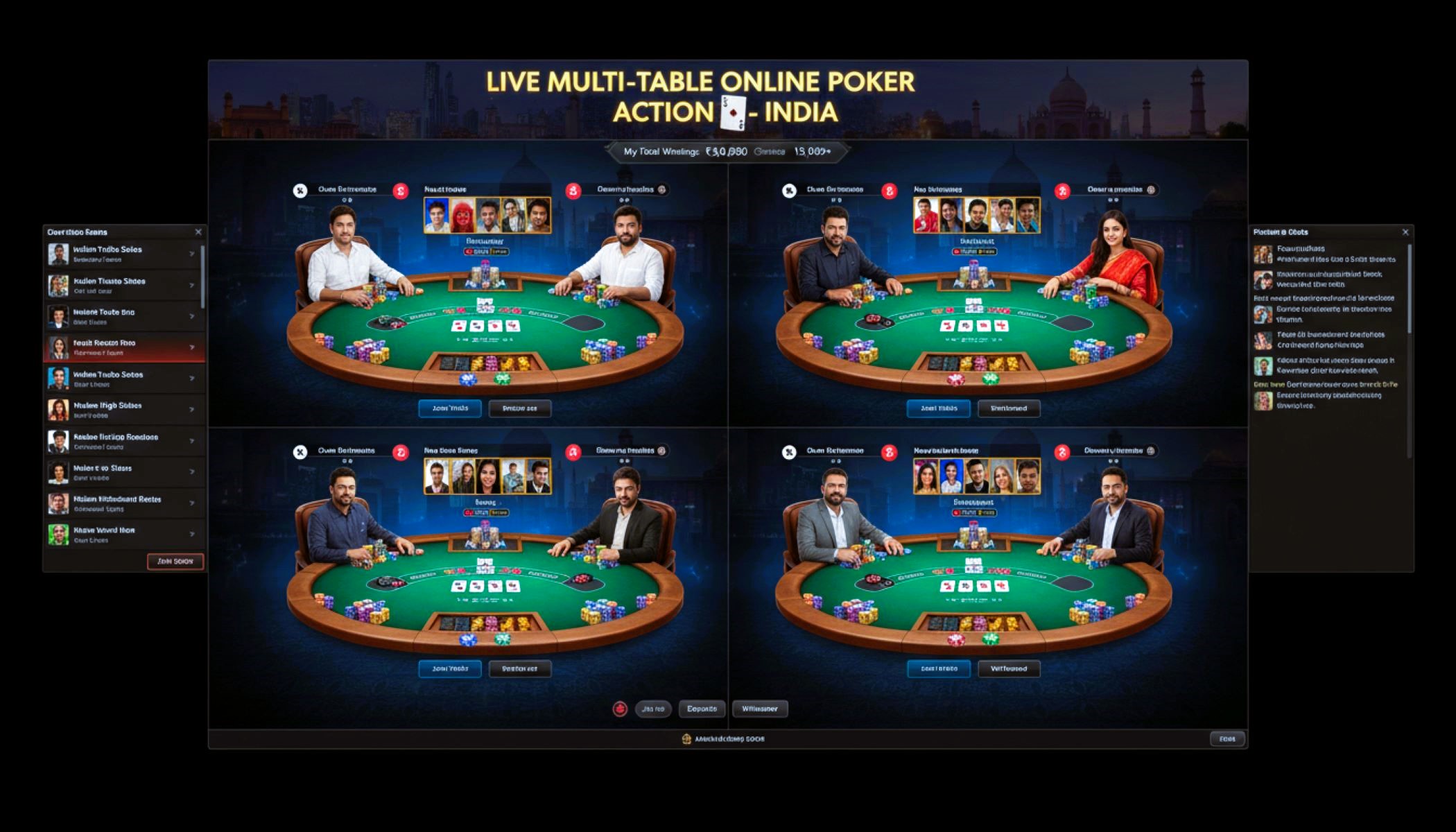
Poker has taken the world by storm, and India is no exception. With the rise of online gambling platforms and the increasing popularity of live poker, Indian players now have unprecedented access to thrilling poker experiences. One format that’s been gaining massive traction is Live Multi-Table Poker (MTP). But what exactly makes this variant so exciting, and why should Indian poker enthusiasts care? Let’s dive in.
What is Live Multi-Table Poker?
Live Multi-Table Poker, often abbreviated as MTP, is a dynamic and competitive online poker format that brings together multiple tables of players into a single, large-scale tournament. Unlike traditional poker games where players sit at a single table, MTP can host hundreds or even thousands of participants simultaneously. This unique structure creates a vibrant, high-energy environment where skill, strategy, and adaptability become crucial to success. Every hand matters, and players must constantly adjust their approach based on changing circumstances at the tables.
In a multi-table poker tournament, players are initially distributed across numerous tables. As the tournament progresses and players are gradually eliminated, tables are merged, reducing the number of competitors while increasing the intensity of the game. This merging process ensures that remaining participants face increasingly skilled and strategic opponents, which adds a layer of challenge and excitement that single-table games cannot offer. It also keeps the pace of the tournament engaging, as the action evolves with every hand and every table consolidation.
One of the defining characteristics of Live Multi-Table Poker is its tournament-style format. Unlike cash games where chips represent real money and can be cashed out at any time, MTP follows a structured progression where players compete for a fixed prize pool. As players advance through the rounds, the stakes rise, forcing participants to make strategic decisions that balance aggression with caution. This competitive design encourages thoughtful gameplay, rewarding both patience and skill while making the tournament thrilling for spectators and participants alike.
Another notable aspect of Live Multi-Table Poker is its ability to offer significantly larger prize pools compared to traditional single-table games. Because the tournament can include so many players, entry fees accumulate into substantial rewards for the top finishers. The combination of large player pools, escalating stakes, and continuous table consolidation creates a unique blend of challenge, excitement, and potential financial gain. For Indian players and enthusiasts worldwide, this format represents one of the most engaging ways to test poker skills against a broad and competitive field.
Why Multi-Table Poker is Booming in India
| Factor | Description | Impact on Players | Market Trend | Example in India |
| Accessibility of Online Platforms | Online poker apps and websites have made joining tournaments effortless, allowing players to participate from home or on the go. | Players can enter tournaments anytime, reducing barriers to entry and encouraging consistent play. | Increasing number of platforms catering specifically to Indian audiences. | Apps like Adda52 and Spartan Poker allow instant registration and real-time play. |
| Rising Poker Culture | Poker is increasingly recognized as a game of skill rather than pure luck, attracting serious players and enthusiasts. | Players focus on strategy, improving their skills and competing at higher levels. | Growth in online poker communities, coaching, and streaming content. | PokerBaazi hosts skill-focused tournaments and promotes strategy guides for players. |
| Massive Cash Prizes | Tournaments now offer substantial prize pools, attracting competitive players seeking financial rewards. | Provides motivation for both amateur and professional players to participate in large-scale events. | Large-scale tournaments continue to increase, with prize pools reaching millions of rupees. | Indian Poker Championship regularly offers prize pools exceeding ₹50 Lakhs. |
| Technological Advancements | Platforms now provide live streaming, real-time updates, multi-table management, and advanced statistics. | Enhances the gaming experience by making gameplay more interactive and transparent. | Continuous innovation in software and app development drives player engagement. | Spartan Poker uses real-time updates and dynamic table management for live MTP events. |
Difference Between Live Multi-Table Poker and Regular Poker
- Number of Players: Single-table poker usually has 2 to 10 players, creating a small, intimate setting where you can easily observe opponents and adjust your strategy. Multi-table poker, in contrast, can include 50 to over 1,000 players, making it much more dynamic and challenging, as you face a constantly shifting pool of competitors.
- Tournament Structure: Single-table poker follows a simple, straightforward format with fixed rounds and little progression. Multi-table poker uses a progressive tournament structure where players are eliminated over time, and tables are merged as the game advances. This structure increases competitiveness and requires long-term strategic thinking.
- Game Duration: Single-table games are generally short, often finishing in minutes to an hour, suitable for casual or beginner players. Multi-table tournaments can last several hours or even a full day, testing players’ endurance, focus, and ability to make consistent, strategic decisions over time.
- Prize Pool: Single-table poker typically has smaller prize pools, limiting the financial rewards. Multi-table poker accumulates larger prize pools from many participants, offering life-changing rewards for top finishers and attracting highly skilled competitors.
- Skill Requirement: Single-table poker requires moderate skill, relying on basic strategy, observation, and understanding of opponent tendencies. Multi-table poker demands high-level skills, including advanced strategy, stack management, psychological insight, adaptability, and the ability to adjust tactics as tables merge and competition intensifies.
- Table Dynamics: In single-table poker, players can predict patterns and behaviors more easily due to the small group size. In multi-table poker, table dynamics constantly change as players are shuffled and eliminated, requiring continuous adaptation and heightened awareness.
- Decision Pressure: Single-table poker offers lower-pressure decisions since stakes are smaller and competition is limited. Multi-table poker involves high-pressure decisions with significant consequences, especially in late stages of the tournament.
- Player Interaction: Single-table poker allows more direct interaction and observation of each opponent, making bluffs and psychological plays easier to execute. Multi-table poker reduces the visibility of individual opponents and increases the importance of statistical play and situational analysis.
- Strategy Evolution: Single-table poker strategies remain relatively static because fewer variables exist. In multi-table poker, strategies must constantly evolve as blind levels increase, stacks fluctuate, and player behavior changes, requiring both tactical flexibility and mental endurance.
Popular Multi-Table Poker Variants in India
India’s poker scene has grown tremendously over the past decade, offering players access to a variety of Multi-Table Poker (MTP) variants that cater to different skill levels and strategic preferences. Among these, Texas Hold’em has emerged as the most widely played version, not just in India but globally. This variant uses two private cards for each player along with five community cards placed on the table, creating multiple possibilities for hand combinations. The strategic depth of Texas Hold’em lies in its balance of probability, psychology, and timing, allowing players to exploit opponent tendencies and position to maximize their chances of winning. Its simplicity in rules combined with complexity in strategy makes it the go-to choice for both beginners and professionals participating in multi-table tournaments.
Omaha Poker is another variant steadily gaining popularity among Indian players. While it shares similarities with Texas Hold’em, the key difference is that each player receives four private cards instead of two. This change increases the number of potential hand combinations, making the game faster-paced and more action-oriented. Omaha demands sharper analytical skills because players must consider a wider range of possibilities when forming hands, and it encourages more aggressive betting strategies. Multi-table tournaments in India featuring Omaha often attract seasoned players who enjoy high-stakes, high-intensity gameplay, as the variant can lead to large swings in chip stacks within just a few hands.
Razz and Seven-Card Stud represent a more traditional style of poker that has started to find its niche among serious Indian players. Unlike Texas Hold’em and Omaha, these games do not rely on community cards, and the focus shifts from forming the highest hand to achieving specific low-hand combinations in Razz or playing the classic stud strategy in Seven-Card Stud. These variants emphasize careful observation, memory, and pattern recognition, as players need to track the cards that have been exposed and deduce what opponents may be holding. Their inclusion in multi-table formats introduces variety and appeals to players who enjoy the technical, strategic depth that comes from non-community card formats.
The diversity of these poker variants ensures that Multi-Table Poker tournaments in India remain engaging and challenging for a wide audience. Players can choose a variant based on their personal preference, skill level, or strategic strengths, allowing them to develop unique approaches to each game. The availability of Texas Hold’em, Omaha, Razz, and Seven-Card Stud within online and live multi-table tournaments reflects the growing sophistication of India’s poker market, offering both casual enthusiasts and professional players multiple avenues to test their skills and compete for substantial prize pools. This range of options keeps the multi-table poker environment fresh, competitive, and continuously evolving in India.
How Live Multi-Table Poker Works
| Stage | Description | Player Experience | Strategic Considerations | Example/Notes |
| Registration | Players sign up for a live multi-table poker tournament through an online platform or app. | Easy access from home or mobile devices; instant confirmation of participation. | Decide buy-in based on bankroll, tournament size, and personal skill level. | Platforms like Adda52 and Spartan Poker offer quick registration for multiple tournaments daily. |
| Seating | Participants are randomly assigned to tables at the start of the tournament. | Players face new opponents, promoting unpredictability and fresh strategies. | Observe your table and note opponent behavior; adjust tactics early to conserve chips. | Random seating ensures fairness and prevents collusion or table stacking. |
| Blinds and Betting | Blinds increase periodically as the tournament progresses to maintain a steady pace. | Keeps gameplay dynamic and pressures players to act strategically with chip stacks. | Plan when to be aggressive or conservative based on stack size and blind levels. | For example, small blind and big blind amounts double every 15–20 minutes in most tournaments. |
| Table Consolidation | As players are eliminated, remaining participants are moved to fewer tables to balance the number of players. | Creates higher competition as skill gaps are revealed; new opponents bring new challenges. | Adapt strategy to changing table dynamics, adjusting aggression and hand selection accordingly. | Tables are merged automatically by the platform, often called “table balancing” or “rebalance.” |
| Final Table | The remaining players compete for top positions and the largest prizes. | High tension and pressure; every decision can determine the outcome. | Use advanced strategies, monitor chip leaders, and exploit weak opponents to maximize winnings. | Final tables often receive live commentary or streaming on major platforms, increasing the thrill. |
Live vs Online Multi-Table Poker
- Live multi-table poker offers real-time interaction with professional dealers, creating an immersive experience that closely mirrors a physical casino environment. Players can see the dealer shuffle and deal cards live, which adds a layer of authenticity and excitement that purely online platforms often cannot replicate.
- The dynamic table movement in live multi-table poker ensures a constantly evolving gameplay experience. As tables merge and players are shuffled, participants encounter new opponents regularly, which demands quick adaptation and keen observation. This element adds both challenge and engagement, keeping the tournament exciting from start to finish.
- Another advantage of live MTP is the authentic casino feel that players can enjoy from the comfort of their own homes. The combination of live dealers, real-time action, and interactive features such as chat or video streaming makes the experience more engaging and socially interactive than standard online-only poker.
- However, live multi-table poker also has some notable challenges. It requires a strong and stable internet connection, as any disruption can affect gameplay or even lead to disqualification in some tournaments.
- The competitive environment can also be intimidating for beginners. Unlike online-only platforms where players can often control pace and pace themselves, live tournaments expose newcomers to highly skilled opponents, creating high-pressure situations.
- Additionally, some live platforms may experience slower gameplay compared to online-only versions, particularly during large tournaments with hundreds of participants. This can affect pacing and may require more patience from players who are used to faster online gameplay.
- Despite these challenges, live multi-table poker continues to grow in popularity in India due to its unique combination of realism, social interaction, and strategic depth, offering a compelling alternative to standard online poker tournaments.